Gabby Petito: The Bodycam Stop That Became the Last Record
Twelve days before Gabby Petito vanished, Moab police stopped the van and the cameras rolled for over an hour. What the footage caught — and what it missed — the full case file.
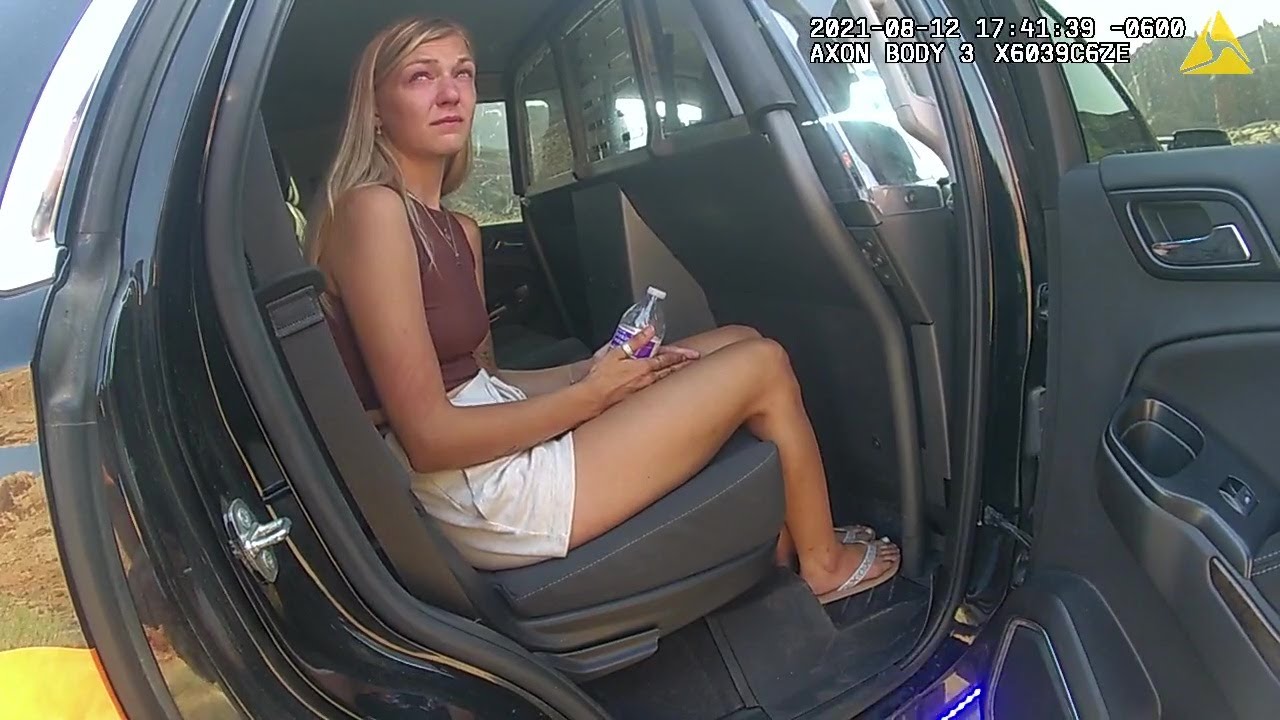
The most-watched hour of police body camera footage in American history begins with a white Ford Transit van pulled over near the entrance to Arches National Park. It's August 12, 2021, late afternoon, Moab, Utah. In the back seat of the patrol car, a 22-year-old woman is crying so hard she can barely finish sentences. The Axon timestamp reads 17:41.
Her name is Gabrielle Petito. In twelve days, she will make her last confirmed contact with her family. Within six weeks, the entire country will be watching this footage frame by frame, asking one question: was the answer already right there on camera?
Background: the van, the trip, the audience
Gabby Petito, 22, and her fiancé Brian Laundrie, 23, left New York in July 2021 on a months-long "van life" road trip west, documenting it for Petito's fledgling YouTube and Instagram accounts. The itinerary ran through Kansas, Colorado, and Utah's national parks, with a planned finish in the Pacific Northwest.
That's the version on camera. Off camera, according to what friends and family later told investigators and reporters, the relationship had a more volatile side — arguments that flared and passed, and a couple that had been living in a 60-square-foot van for weeks in summer heat.
On August 12, the two versions collided in public, in front of a witness with a phone.
The 911 call
The stop wasn't random. A caller told Grand County dispatch he'd seen a couple arguing outside the Moonflower Community Cooperative in downtown Moab — and that the man had slapped the woman. The caller reported they'd driven off in a white van with Florida plates.
That call matters enormously in hindsight, for one reason: what the caller described — man hits woman — is nearly the opposite of the conclusion officers would reach an hour later.
The footage: an hour that's hard to watch twice
Moab officers stopped the van after seeing it cross a curb near the Arches entrance. The bodycam and dashcam footage — released publicly and later examined in an independent review — runs over an hour across multiple cameras. Watched carefully, it breaks into three movements.
1. The first account
Petito is visibly distraught from the first frames — crying, hyperventilating, apologizing. She tells officers the couple had been fighting all morning, that the tension had been building for days, and that she'd hit Laundrie first during the struggle in the van. Asked directly whether Laundrie hit her, her answer on camera is halting: "I guess, yeah. But I hit him first." She points to her cheek, describing a grab: "he grabbed me with his nail... I definitely have a cut right here."
Laundrie, interviewed separately, is calm, cooperative, even joking with officers. He shows scratches on his face and arm. He frames the incident as Gabby's anxiety spiraling — a stressed girlfriend, a messy van, nothing serious.
The contrast in demeanor — her distress, his ease — becomes the axis on which the entire encounter turns.
2. The classification decision
The officers confer, on camera, about what they have. A slap reported by a witness. A woman with a visible mark. A man with scratches. Utah law strongly encourages — and in domestic assault cases can require — a citation or arrest when there's evidence of an offense.
Their resolution, worked through in real time on the footage: this is a mental/emotional health episode, not a domestic assault — and to the extent anyone was an aggressor, the paperwork would name Petito, based on her admission that she struck first. No charges. The "remedy" is separation: Laundrie is put up in a motel for the night; Petito keeps the van.
One officer tells Laundrie, almost apologetically, that he shouldn't consider himself a victim of a crime. The couple is sent on their way — together again by the next day.
3. The moment nobody caught
Buried in the second officer's footage — released later — is the detail that hit hardest in retrospect. The 911 caller had reported a man slapping a woman. On the released audio, that report is right there in the dispatch information. The final incident report never reconciled the eyewitness account with the on-scene conclusion.
The footage doesn't show officers being cruel or lazy. It shows something more unsettling: procedure applied earnestly, in good faith, arriving at the wrong read — with the evidence of the discrepancy sitting inside their own recordings.
Twelve days
What followed the stop is now one of the most documented timelines in modern crime:
- August 24 — Petito video-calls her mother; it's the last conversation. Around this time the couple is at a dispersed campsite in the Spread Creek area of Bridger–Teton National Forest, Wyoming.
- Late August — Petito's family receives text messages they later describe to investigators as uncharacteristic — including one referencing a grandfather by first name, which her mother flagged as something Gabby would never do. The family came to believe someone else was using her phone.
- September 1 — Laundrie arrives back in North Port, Florida, driving the van. Alone. He says nothing to Petito's family.
- September 11 — Petito's parents, unable to reach her or the Laundries, report her missing. The van is seized; Laundrie retains a lawyer and does not speak to police.
- September 14 — Laundrie tells his family he's going hiking in the Carlton Reserve. He is never seen alive in public again.
- September 19 — Remains are found at the edge of the Spread Creek camping area, aided in part by a family of travel vloggers who realized their own campsite video had captured the white van on August 27. The remains are confirmed as Petito's.
- Coroner's finding — Homicide. Manual strangulation. The coroner estimated death occurred three to four weeks before discovery — placing it in the last days of August, roughly two weeks after the Moab stop.
The search for Laundrie ended on October 20, 2021, when his remains — dead by suicide — were found in a section of the Carlton Reserve that had been underwater for weeks. Near the body: a backpack, and a notebook.
In January 2022, the FBI closed the case with a final disclosure: the notebook contained written statements in which Laundrie claimed responsibility for Petito's death. He was never charged with her murder; the only charge ever filed against him was federal debit-card fraud for using her card after her death.
The reckoning over the stop
With the case closed, attention returned to the hour of footage from Moab.
The City of Moab commissioned an independent review of the August 12 stop. Its conclusions, released publicly: the officers made "unintentional mistakes" — most centrally, misclassifying an incident that, under Utah's domestic violence statutes, likely required a citation. The review found the officers did not follow the letter of the law, while also noting they showed genuine concern for the couple.
Petito's parents filed suit against the Moab Police Department, alleging that the department's failures that day contributed to their daughter's death — litigation that worked its way through Utah courts in the years after. Separately, the family pursued and settled claims connected to the Laundrie family, and Petito's parents channeled much of their effort into the Gabby Petito Foundation, focused on domestic violence intervention and missing-persons resources.
The case also forced a harder public conversation the family themselves helped lead: the phrase "missing white woman syndrome" — the reality that thousands of missing Indigenous, Black, and brown women receive a fraction of the attention Gabby's case commanded. Her family has repeatedly said they want the machinery that found their daughter to work for everyone's daughter.
What the footage teaches
We break down body camera video on this channel every week — here's our full guide to reading it like an investigator — and the Moab stop remains the single most instructive hour in the genre. Not because the officers were villains — the record doesn't support that — but because of what it shows about the medium itself:
- Demeanor is not evidence. The calm party reads as credible; the distraught party reads as the problem. Trauma responses invert that logic, and the camera faithfully records the inversion.
- The first classification decides everything. "Mental health episode" and "domestic assault" trigger different laws, different paperwork, different follow-ups. The label chosen in minute 20 shaped everything after.
- The record contradicts itself — quietly. The 911 report of a slap and the on-scene conclusion never meet. No one lies; the discrepancy just sits there, unresolved, on tape.
- A camera can only capture the moment it's pointed at. The footage shows August 12. The homicide came later, elsewhere, off camera. The stop was a window — the last official one — not the crime.
Why this case file matters
There is no trial in this file. No verdict, no sentencing hearing, no cross-examination. The man the FBI says claimed responsibility died before he could be charged, and the legal system's only convictions were procedural footnotes.
What's left is the record: sixty-some minutes of body camera footage, a 911 call, a coroner's ruling, a notebook, and an independent review that reads like an autopsy of a decision. It is the rare case where the most important evidence isn't about proving who did it — it's about understanding what everyone standing right there couldn't see.
The search-phase lesson of this case — that sustained public attention can move a missing persons investigation — is playing out again right now in the disappearance of Elizabeth Waddell, an American mother missing in Grenada since July 22, 2026.
Case status as of this writing: closed. Brian Laundrie was identified by the FBI as claiming responsibility for Petito's death in writing; he died by suicide in October 2021 and was never charged with her murder. Civil matters arising from the case proceeded in the years after. This article is based on publicly released bodycam footage, the City of Moab's independent review, FBI statements, the Teton County coroner's findings, and contemporaneous reporting. Photo: still from Moab City Police Department body camera footage, August 12, 2021 (public record).
Reported to our editorial standards: records first, charges reported as charges, corrections welcomed.
Frequently asked questions
What happened during the Moab police stop of Gabby Petito?+
On August 12, 2021, Moab police stopped the couple's van after a 911 caller reported seeing a man slap a woman. Over roughly an hour of bodycam footage, officers interviewed Petito and Laundrie separately, classified the incident as a mental-health episode rather than a domestic assault, listed Petito as the primary aggressor, and separated the couple for the night instead of making an arrest.
How did Gabby Petito die?+
Petito's remains were found on September 19, 2021, near a dispersed campsite in Wyoming's Bridger–Teton National Forest. The Teton County coroner ruled her death a homicide by manual strangulation, estimating she died three to four weeks before her body was found.
Was Brian Laundrie ever charged with Gabby Petito's murder?+
No. Laundrie was charged federally only with unauthorized use of Petito's debit card. He was found dead by suicide in Florida's Carlton Reserve in October 2021. In January 2022, the FBI announced that a notebook found near his remains contained statements claiming responsibility for Petito's death, and the case was closed.
Did the Moab police do anything wrong?+
An independent review commissioned by the City of Moab concluded the officers made 'unintentional mistakes' — including misclassifying the incident — and that Utah law likely required a citation in a domestic violence incident. Petito's parents sued the department; the litigation and its outcome played out in Utah courts over the following years.
Why is the Gabby Petito case so significant?+
It combined a real-time social media search, publicly released bodycam footage of a police contact weeks before a homicide, and a national conversation about how officers assess domestic violence — plus scrutiny of how missing-person cases receive attention. It reshaped public understanding of what a 'routine' police stop can miss.
Stay On The Case
Get the next case file first
One email when a new case drops — footage, records, and the full breakdown.
Subscribe on YouTubeRelated case files
 Body Cam Breakdowns
How to Watch Body Cam Footage Like an Investigator
Body cam footage shows more than most viewers notice. Learn what investigators look for — timestamps, angles, audio gaps, and the moments that decide cases.
 Body Cam Breakdowns
True Crime Documentaries Built From Bodycam Footage: The Definitive List
No narrator, no reenactments — just the record. The documentaries and series built from real police bodycam footage, what each one shows, and where to stream them.
 Body Cam BreakdownsCIVIL CITATION
Tony Romo's Bodycam: What the OWI Arrest Footage Actually Shows
'I've already heard from all the lawyers.' The Milwaukee bodycam of the ex-Cowboys QB's OWI stop, broken down — the stop, the tests, the refusals, and why it isn't a criminal case.