Mistrial in the Lindsay Clancy Trial: The 11-1 Deadlock, the One-Hour Stay, and What Happens Now
After seven days and roughly 38 hours of deliberations, a hopelessly deadlocked jury — split 11 to 1 — ended the Lindsay Clancy murder trial without a verdict. The judge announced a mistrial; the defense raced to the state's highest court to stop it. What a mistrial actually means, whether Clancy will be retried, and what happens to her now.
Seven days. Roughly 38 hours of deliberation. Three deadlock notes, a "dynamite charge," a fight over a single holdout juror — and, in the end, no verdict at all.
On Friday, September 4, 2026, Judge William Sullivan told a Plymouth Superior Court courtroom that the law left him no choice: with the jury hopelessly deadlocked for a third time, he would declare a mistrial in the murder trial of Lindsay Clancy — the Duxbury labor-and-delivery nurse charged with killing her three children on January 24, 2023. Then came a twist fitting the strangest deliberation Massachusetts has seen in years: Sullivan paused his own ruling, giving defense attorney Kevin Reddington a window to run to the state's highest court — the Supreme Judicial Court — with an emergency bid to stop the mistrial and keep this jury. A single SJC justice took the motion under advisement, then denied it — and Sullivan formally declared the mistrial. It is now final.
✅ UPDATE — IT'S OFFICIAL: THE MISTRIAL STANDS. The Supreme Judicial Court denied the defense's emergency stay, and Judge Sullivan then formally declared a mistrial in open court. The first Lindsay Clancy trial is over with no verdict. What's left is the decision that now controls everything: whether the Plymouth County District Attorney retries the case, negotiates a resolution, or lets it go. We'll update this file when that call is made.
That inversion — the defense fighting to prevent a mistrial — is the key to understanding everything that happened this week.
The deadlock was 11 to 1 — and everyone knew which way
The jury of nine women and three men got the case August 27 with five verdict options, from first-degree murder to not guilty by reason of lack of criminal responsibility — the insanity verdict the defense sought, which means secure psychiatric commitment, not freedom. They deliberated longer than almost anyone predicted: through requests for Clancy's pill bottles and the knife, through two deadlock notes, through the one-time Tuey-Rodriguez "dynamite" instruction, and through a question about reasonable doubt that detonated Thursday's hearing.
That's when the split became public. Reddington moved to remove a single juror who he said "refuses to listen to the law … on reasonable doubt." Sullivan declined — and in declining, said it plainly: "I don't feel it's appropriate for me to say I agree with one juror or the 11." Eleven to one. And the defense's fury at the holdout told the courtroom which way the eleven leaned. By Thursday evening Reddington had abandoned any pretense of wanting a do-over: "Why would I want a mistrial? I kicked the s--- out of their case."
Friday morning's inquiry into the holdout changed nothing. The jury reported, again, that it could not agree. Under Massachusetts law, Sullivan had exhausted his tools — a judge may send a deadlocked jury back only twice without its consent, and the dynamite charge is given once. Mistrial was, as he put it, what he must declare.
The one-hour Hail Mary
Reddington's answer was an emergency stay application to the Supreme Judicial Court — an extraordinary attempt to have the state's highest court freeze the mistrial and, presumably, force continued deliberations or some other remedy that preserves the eleven votes he believes he has. Sullivan granted one hour for the filing before finalizing his ruling. Legal analysts immediately called the bid a long shot: appellate courts almost never interfere with a trial judge's finding that a jury is genuinely hung, and "manifest necessity" — the standard that justifies a mistrial — is exactly what three deadlock notes establish. But a long shot was the only shot left: once the jury is discharged, it cannot be reassembled.
What a mistrial actually means for Lindsay Clancy
Start with what it is not. A mistrial is not an acquittal, not a conviction, and not an exoneration. The three first-degree murder charges remain exactly where they were. Clancy — paralyzed from the waist down since her suicide attempt the night of the killings — remains in custody at a state psychiatric hospital, precisely as she has been since 2023. Nothing about her situation changes today except the calendar.
And double jeopardy does not save her from a second trial. The Fifth Amendment bars retrial after an acquittal — but a hung jury is the textbook exception. When a mistrial is declared out of manifest necessity, the Commonwealth may retry the entire case, from jury selection to closing arguments, as if the first trial never happened. Whether it will is now the question that matters most, and it is genuinely open:
- The defense says it's ready — Reddington told reporters he could try the case again "as early as next week," even while telling them Clancy herself "can't handle another trial."
- The prosecution has committed to nothing. Through three days of deadlock coverage, the Plymouth County District Attorney's office declined to say whether it would seek a retrial at all. An 11-1 count against the state's position — if that's what it was — is exactly the arithmetic that pushes prosecutors toward a negotiated resolution instead: a plea, or a stipulated finding of lack of criminal responsibility that sends Clancy to a secure hospital without another jury.
That last path is how cases like this often actually end — it is, in substance, how the Andrea Yates saga concluded: conviction, reversal, and finally an insanity verdict at retrial in 2006. Yates's ex-husband Rusty, watching this case, said this week the Clancy facts are "not quite as clear" — and eleven jurors apparently disagreed with him.
Why one juror was enough
However maddening for both sides, this is the system functioning exactly as designed: a unanimous-verdict requirement means one sincere holdout can hang any jury, and the remedy is a new trial, not a majority vote. Massachusetts asked twelve people to decide where postpartum psychosis ends and criminal responsibility begins — a question the psychiatrists themselves spent five weeks disputing — and twelve people could not unanimously answer it. Our full record of how they got there — every witness, every expert, every deadlock note — is in the complete trial file, and every next date in this case will be tracked on the court dates tracker as it lands.
Why this case file matters
Thirty-eight hours of deliberation is not a jury failing; it's a jury refusing to pretend an impossible question is easy. Whatever the Commonwealth decides — retry, resolve, or relent — the first Clancy trial ends the way the hardest cases sometimes must: with the record complete, the question undecided, and the law's most uncomfortable feature on full display — that certainty beyond a reasonable doubt is a standard, not a guarantee.
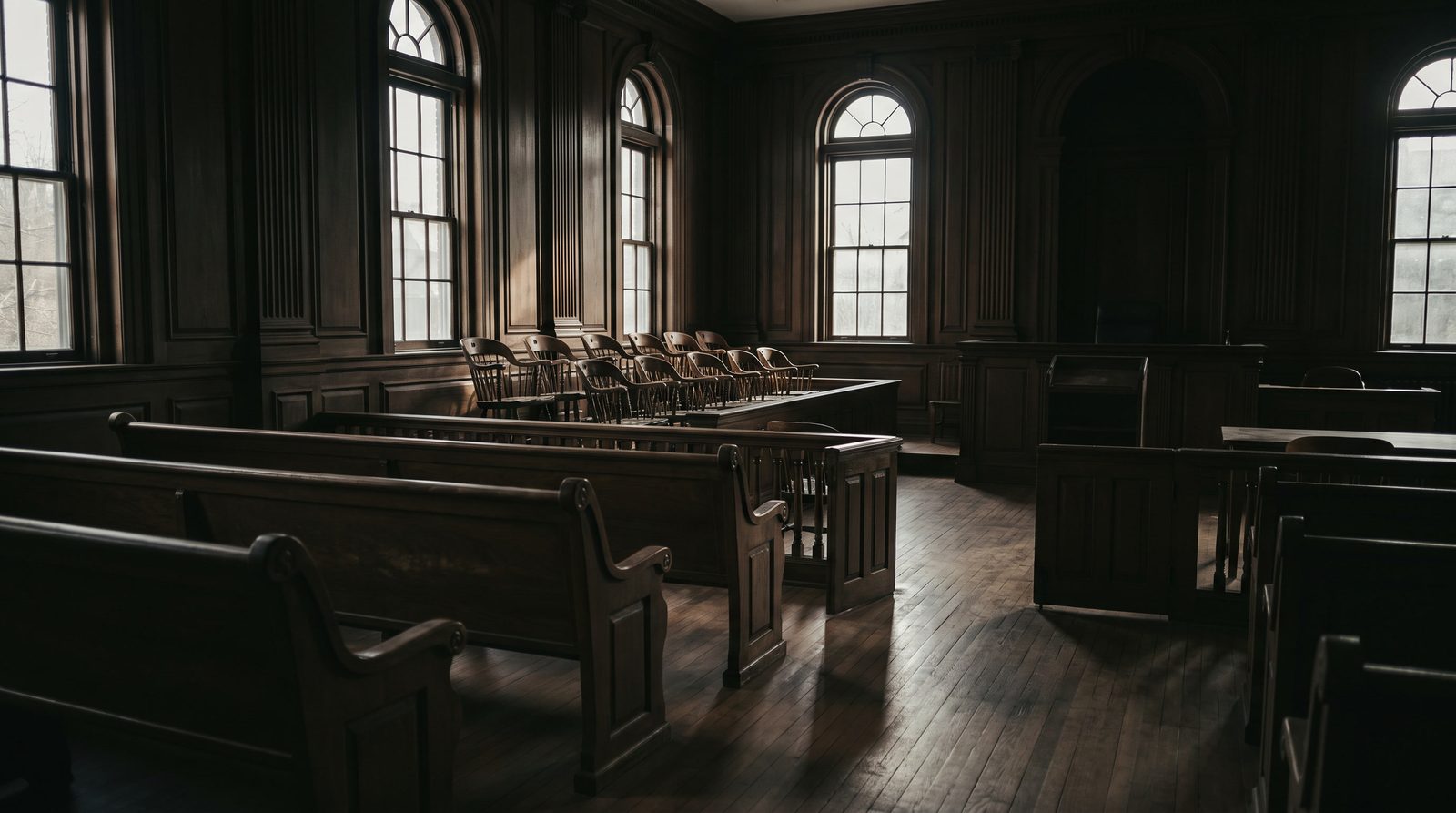
Case status as of this writing: on September 4, 2026, after the jury's third deadlock report, Judge William Sullivan moved to declare a mistrial; the defense's emergency stay application was denied by a single justice of the Massachusetts Supreme Judicial Court, and Sullivan then formally declared the mistrial. The first trial is over with no verdict; a retrial decision rests with the Plymouth County District Attorney, and this page will be updated when it is made. Lindsay Clancy remains charged with three counts of first-degree murder, has pleaded not guilty, and is presumed innocent unless and until proven guilty. This article is based on court proceedings and contemporaneous reporting by NBC News, AP, Reuters, CBS News, and others. Featured image: AI illustration of an empty New England courtroom created for this article.
Reported to our editorial standards: records first, charges reported as charges, corrections welcomed.
Frequently asked questions
Was there a verdict in the Lindsay Clancy trial?+
No. After seven days and roughly 38 hours of deliberations, the jury reported for a third time that it could not reach a unanimous decision — deadlocked 11 to 1, per the judge's own description of the split. On September 4, 2026, Judge William Sullivan announced he would declare a mistrial, granting the defense a one-hour window to seek an emergency stay from the Massachusetts Supreme Judicial Court before the ruling became final.
Does a mistrial mean Lindsay Clancy goes free?+
No. A mistrial is not an acquittal — it means the trial ended without any verdict. The charges against Clancy remain fully in place, and she remains in custody at a state psychiatric hospital, exactly as she was before trial. Only a not-guilty verdict, a verdict of not guilty by reason of lack of criminal responsibility, or the Commonwealth dropping the charges would change her status.
Can Lindsay Clancy be retried after a mistrial?+
Yes. Double jeopardy does not bar a retrial after a hung jury — a mistrial declared for manifest necessity, like an irreconcilable deadlock, allows the prosecution to try the case again from the beginning. Whether the Plymouth County District Attorney will actually retry the case is a separate decision, and notably, prosecutors have not committed to one. Defense attorney Kevin Reddington has said he would be ready 'as early as next week' — while also arguing he'd rather keep this jury, saying, 'Why would I want a mistrial? I kicked the s--- out of their case.'
Why did the defense try to stop the mistrial?+
Because of the arithmetic. Judge Sullivan's own words — that he couldn't side 'with one juror or the 11' — confirmed the jury was split 11-1, and the defense's push to remove the lone holdout strongly suggested the eleven favored Clancy's side. For the defense, this jury was one juror away from the best realistic outcome; a mistrial throws that away and risks a new jury. That's why Reddington sought an emergency stay from the Supreme Judicial Court rather than welcome the do-over — a bid legal analysts called a long shot.
What was the jury deciding in the Clancy case?+
Whether Clancy was criminally responsible for the January 24, 2023 killings of her three children — Cora, 5, Dawson, 3, and Callan, 8 months. The defense argued she was in postpartum psychosis, acting on command hallucinations; the state argued she planned the killings and knew they were wrong. Jurors had five options: first-degree murder, second-degree murder, manslaughter, not guilty, or not guilty by reason of lack of criminal responsibility.
Verdict Watch
The verdict, the day it lands
Clancy. Fernandez. Gardner. One email when a jury comes back or a major case breaks — the full breakdown, same day. No spam, ever.
Subscribe on YouTubeRelated case files
 Trials & Verdicts
Not Guilty by Reason of Insanity: What Actually Happens Next (It's Not Freedom)
The Clancy jury will be asked the hardest question in criminal law: not what she did, but whether she could be responsible for it. How the insanity defense really works — and how rarely it does.
 Trials & VerdictsMISTRIAL
Lindsay Clancy Trial Updates: Verdict Watch, Closing Arguments, and the Full Case File
Three children dead, a mother paralyzed by her own suicide attempt, and a defense built on postpartum psychosis. Closing arguments are done — the jury is deliberating between murder, manslaughter, and insanity. The full case file, updated the moment the verdict lands.
 Trials & VerdictsVERDICT: GUILTY
Blaise Taylor: The NFL Scout, the Pink Lemonade, and a Two-Hour Verdict
She told a friend, 'I know you put something in my drink.' Nine days later she was dead. On July 1, 2026, a Nashville jury took two hours to convict the ex-Titans scout. The full case file.