Inside the 'Woodchipper Plot' Court File: Ordering 3 Murders From a Jail Cell
We read the FBI's 20-page sworn affidavit in United States v. Aaron Corey — the Albany '764' case the headlines compressed into 'woodchipper plot.' The full file is stranger: three handwritten letters, a fake hitman called 'the apostle,' coded talk of 'landscaping' and 'logs,' PayPal invoices for 'Tools — 5 x $40,' and a sting that ran entirely inside the jail's own recording systems.
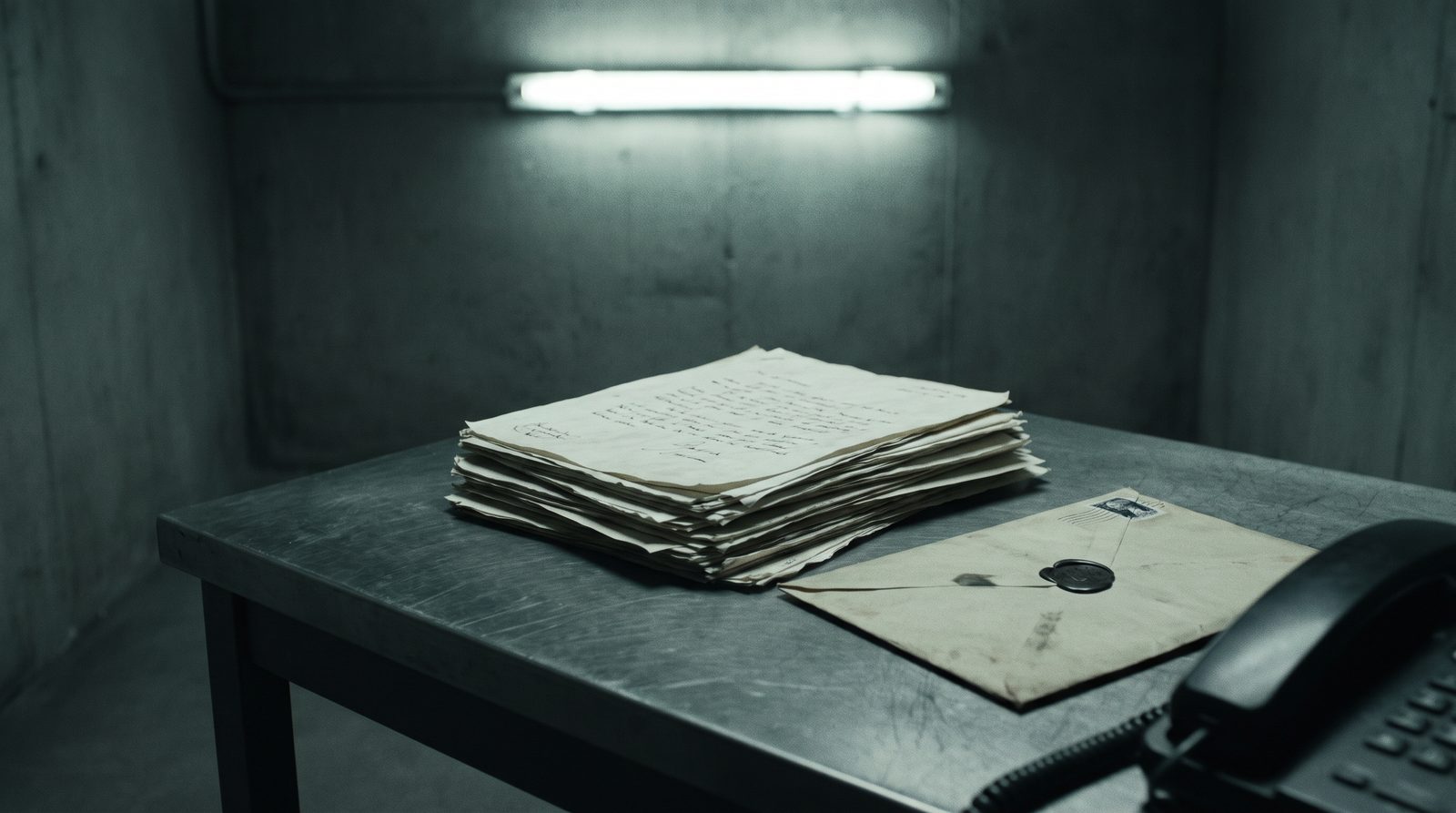
Here is the detail that makes this case file almost impossible to look away from: every single step of the alleged plot ran through systems built to record it. The letters went through jail mail. The calls went out on a line that announces it is recorded. The messages were typed on a jail-issued tablet that logs everything. And according to the FBI's sworn affidavit, the man sending them knew — he schemed about the surveillance, in writing, on the surveilled channels.
The headlines in early July compressed United States v. Aaron Corey (N.D.N.Y., No. 1:26-mj-00152) into two words: woodchipper plot. We pulled the 20-page affidavit sworn by FBI Special Agent Brian Jacob — a 23-year agent on Albany's Safe Streets Task Force — and read all of it. The document is far stranger, and far more procedurally interesting, than the headlines. Everything below comes from that filing. Corey has pleaded to nothing, been convicted of nothing, and is presumed innocent; this is the government's account, under oath, of what it says happened.
The man in the cell
Per the affidavit, Aaron Corey's devices — three phones, two computers — were seized in a December 19, 2025 New York State Police drug search of his Albany home. Investigators say they found child sexual abuse material on them, and in February 2026 Corey was charged federally with receipt of child pornography and ordered detained pending trial. Two FBI agents were assigned to that case. So was a federal prosecutor.
Those three people, the government alleges, became a kill list.
In mid-May 2026, an inmate at the same county jail began receiving handwritten letters from Corey — three in all. Instead of flushing them as instructed, the inmate mailed every one to his own attorney, who handed them to the FBI. The first letter introduced the sender: he goes by "Baggeth," is a "known associate of 764," and has founded two spin-off groups, Bloodbath and Plasmabath. His own definition of the movement, verbatim: "It's essentially a community of individuals online that reject authority, law enforcement, morals, ethics, and/or the government in general."
Then the letter got to business. First, a $700 job: sneak into the FBI's Albany office, swap his five seized devices for lookalikes, and hold the originals until his case ended. And then, four words the affidavit quotes in full: "I need 3 people killed." (Compl. ¶ 9.) The names below them: the two FBI agents on his case, and his prosecutor. The stated logic, from a later letter: "in order to beat my case and get my shit dismissed, they need to be dealt with." The method he described — kidnapping, a lethal fentanyl dose, and a filmed woodchipper — is the part every headline ran with, and it is as grim as reported. The letter even listed five songs to score the video with, and closed with a plan for afterward: "once I do [beat my case], I'm gonna sue the shit out of them." (Compl. ¶¶ 23–26.)
One more detail the coverage missed: the list was maintained. When the original prosecutor resigned in May for unrelated reasons, Corey allegedly wrote a follow-up letter swapping in the name of the new prosecutor assigned to his case — "I'll create an updated list for ease of access on the back of this page." (Compl. ¶ 14.)
Enter "the apostle"
On June 11, the FBI made its move — not with a raid, but with a phone number. Agents passed the inmate (through his attorney) a number for a supposed "connect," and that evening Corey called it from a recorded jail line. The man who answered was an undercover officer. When Corey later addressed a letter to "JP (John Paul)" — guessing at the initials — the UC laughed it off on the next call: "You can just call me the apostle from now on."
The letter Corey wrote to his new hitman never even left the building. On June 18, agents seized it from the jail's outgoing mail under a federal search warrant, scanned it, and handed the copy to the undercover officer so the negotiation could continue. It opened "Hey this is Baggeth" and laid out "Job #1" (the device swap, $200 down and $500 after) and "Job #2," captioned in Corey's own hand: "3 Person Killing" — $30,000 on completion. On locating the victims: "you will need to figure out the location of each individual, mainly cuz I can't from jail. I'm sure that's not difficult for you; everyone lives somewhere LOL."
"Landscaping," "logs," and "power tools"
Because every call was recorded, the affidavit says, the negotiation moved into improvised code — and the transcribed exchanges are the heart of the file. The UC, testing whether Corey was really attached to the woodchipper: "the landscaping at the end right with the woodchipper . . . that's all day. Um, no problem. But the, before that when we are preparing the logs . . . that's kind of my area of expertise, and it just might be done another way." Corey's answer: "I just threw that in there as a suggestion pretty much . . . I know you're the fucking expert in that field." (Compl. ¶ 30.) Agent Jacob translates for the court: "landscaping" is the murder scheme; "logs" are the three victims.
The same vocabulary shows up in Corey's tablet messages to a woman abroad the affidavit calls Individual 1 — his fiancée, who was to handle the payments: "Hes trustworthy trust me. Hes worked on landscaping projects before its nothing new for him." His seized devices became "power tools." When the UC stalled, he told her the hitman would send "a pic of the golf course hes at rn lol."
The invoice that says "Tools — 5 x $40"
On June 23, the undercover officer did something almost bureaucratically surreal: he sent PayPal invoices. Invoice 1, for Job #1: $200, itemized "Tools," "5 x $40" — forty dollars per stolen federal device. Invoice 2 referenced the $500 down payment against the $30,000 total for Job #2. Individual 1 paid the $200 within hours.
Then she saw the second invoice. Her message to Corey, quoted in the affidavit: "Ask ur friend if the 30.000 is a mistake because I feel insanely scammed right now." (Compl. ¶ 42.) Corey's reply — "Yes it was a mistake. Call me bac" — was followed by a damage-control call to the UC: she'd only handle the small payments; "the rest of it, that, the 30" he would cover himself when it was done. The affidavit is notably careful here, twice stating it is unclear whether and to what extent Individual 1 knew what the payments were actually for. She is charged with nothing in this filing.
The sting's final beat is the file's best: the UC claimed he'd bribed someone inside the FBI ($5,000 — "just add it to the final price," Corey allegedly offered) to pull off the device theft. On June 25, agents signed their own evidence out of the Albany field office, photographed it, and sent the pictures as proof of a burglary that never happened. Individual 1 received the photos and paid the $500 — which the government says was the down payment on three murders. Four days later, the complaint was sworn out.
What the file says about 764
Five paragraphs near the end do something federal filings rarely slow down for: they define, under oath, what the FBI means by Nihilistic Violent Extremists — networks whose goal is "a hatred of society at large and a desire to bring about its collapse by sowing indiscriminate chaos," who groom and extort vulnerable people, including minors, into self-harm, exploitation, and violence, and who rebrand constantly while "the core members and goals remain consistent." 764 and its offshoots, the affidavit says, are the flagship example. Read against that section, the government's theory of this case is not just a jailhouse revenge plot — it's what that ideology looks like when its adherent is in a cell with nothing but paper, a tablet, and a recorded phone.
What happens next
Corey was arrested on the new complaint June 30 and appeared before Magistrate Judge Daniel J. Stewart the same day; attorney John S. Wallenstein was appointed. On July 7 the parties stipulated to a 60-day extension of the deadline to indict — which makes early fall 2026 the window to watch for a grand jury indictment on the murder-for-hire, solicitation, and obstruction counts. The underlying child-pornography case is also still pending. If convicted on the murder-for-hire count alone, he faces up to 10 years per victim solicited; the government will argue the letters speak for themselves, and the defense — which has not yet answered the allegations in any filing we've seen — will have its say. We'll update this file when the indictment lands.
How we sourced this — and how you can too
This is the third installment in our From the Court File series, built from primary court records instead of headlines — the first read the federal file in the Lil Durk trial, the second the forfeiture complaint in the case where the U.S. is suing 158 bitcoin, and the fourth the USPS mail-ballot whistleblower disclosure. The Corey complaint is public: N.D.N.Y. No. 1:26-mj-00152 (the underlying case is No. 1:26-mj-00025), on PACER and mirrored free on CourtListener's RECAP archive. Every quotation above is from the sworn affidavit at Docket 1.
Why this case file matters
Strip away the shock detail and this file documents something genuinely rare: an alleged murder-for-hire investigated entirely inside the surveillance the target already knew about — recorded lines he scheduled his calls on, a mail system he tried to route around, a tablet that logged the words "very proud of you" next to a payment for what prosecutors say was a contract killing. The affidavit even preserves his workaround research: a letter describing how to disguise a phone number as an attorney's emergency contact so calls go unrecorded. The record, as always, is the story — a man allegedly trying to erase the evidence in one federal case generated twenty sworn pages of it in another.
Case status as of this writing: Aaron Corey is charged by criminal complaint in United States v. Corey, No. 1:26-mj-00152 (N.D.N.Y., filed June 29, 2026), with murder-for-hire, solicitation of a crime of violence, and attempted obstruction; a separate charge of receipt of child pornography is pending at No. 1:26-mj-00025. He has not been indicted or convicted in either matter and is presumed innocent unless and until proven guilty. All quotations are from the criminal complaint affidavit (Dkt. 1) and reflect the government's allegations. The FBI agents, prosecutors, cooperating witness, and Individual 1 are anonymized in the filing and therefore here. Featured image: AI illustration created for this article; it does not depict the actual documents or jail.
Reported to our editorial standards: records first, charges reported as charges, corrections welcomed.
Frequently asked questions
What is Aaron Corey accused of?+
Per an FBI criminal complaint filed June 29, 2026, in the Northern District of New York (Case No. 1:26-mj-00152), Corey — already jailed on a federal charge of receipt of child pornography — allegedly tried to hire a hitman from inside a county jail to murder the two FBI agents and the federal prosecutor handling his case, and separately to have his seized electronic devices stolen from the FBI's Albany office. He is charged with murder-for-hire, solicitation of a crime of violence, and attempted obstruction of an official proceeding. These are allegations; Corey is presumed innocent unless and until proven guilty.
Was anyone actually in danger?+
According to the affidavit, no hitman ever existed. The 'connect' Corey was allegedly negotiating with was an undercover law enforcement officer introduced by the FBI on June 11, 2026, after a fellow inmate reported the plot through his attorney. Even the 'proof' that Corey's devices had been stolen from the FBI was staged — agents signed out their own evidence, photographed it, and sent the photos as if the theft had happened.
What is 764?+
The affidavit describes 764 as a network of what the FBI calls Nihilistic Violent Extremists — online groups that target and exploit vulnerable people, including minors, with the stated goal of destabilizing society. In his first letter, Corey allegedly introduced himself as 'Baggeth,' a 'known associate of 764,' and claimed to have created two spin-off groups called Bloodbath and Plasmabath. The affidavit devotes five numbered paragraphs to defining the movement — one of the fuller sworn descriptions of 764 in a public federal filing.
What happens next in the Aaron Corey case?+
Corey was arrested on the new complaint June 30, 2026, made his initial appearance the same day before Magistrate Judge Daniel J. Stewart, and had counsel appointed. On July 7 the parties stipulated to a 60-day extension of the Speedy Trial Act deadline to indict, which points to a possible indictment in early fall 2026. His underlying child-pornography case also remains pending. He has not been convicted of anything in either matter.
How can I read the court file myself?+
The complaint and affidavit are public records: United States v. Aaron Corey, No. 1:26-mj-00152 (N.D.N.Y., filed June 29, 2026), with the underlying case at No. 1:26-mj-00025. Filings are on PACER, and the 20-page affidavit is mirrored free on CourtListener's RECAP archive. Everything quoted in this article comes from that document.
Verdict Watch
The verdict, the day it lands
Clancy. Fernandez. Gardner. One email when a jury comes back or a major case breaks — the full breakdown, same day. No spam, ever.
Subscribe on YouTubeRelated case files
 Case FilesON TRIAL
We Read the Lil Durk Court File: 5 Things the Documents Say the Headlines Don't
We pulled the actual federal court file in United States v. Banks — the FBI agent's sworn affidavit and the government's trial memorandum — and read every page. An alleged earlier hit attempt in Georgia, a Christmas Day 'peace' rejection, a group chat called 'The Family,' and a second trial nobody is talking about.
 Case FilesTRO IN EFFECT
Inside the USPS Whistleblower File: One Bad Barcode, 10,000 Rejected Ballots
We read the 27-page whistleblower disclosure just filed in federal court over the Postal Service's new mail-ballot 'Portal' — a system built in weeks, tested for days, and designed so a single failed barcode scan rejects an entire batch of ballots. What the court file actually says, who's alleging what, and where the litigation stands two months before the midterms.
 Case FilesFORFEITURE PENDING
The U.S. Is Suing 158 Bitcoin — Silk Road Drug Money That Hid for 13 Years
In a Manhattan courtroom, the defendant is a pile of cryptocurrency. We read the government's forfeiture complaint: Silk Road drug proceeds cashed out through a German broker in 2013, frozen in the Mt. Gox collapse for a decade, and seized the day the bankruptcy finally paid out — now worth about $12.6 million.